Comma Categories
Another useful example of a category is a comma category. The term comes from the original notation which has since fallen out of favor because, as Saunders MacLane put it, “the comma is already overworked”.
We start with three categories  ,
,  , and
, and  , and two functors
  and
and  . The objects of the comma category
  are triples
  where
where  is an object of ,
  is an object of , and
  is an arrow
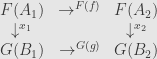
  in . The morphisms are pairs
  — with
  an arrow in and
  an arrow in — making the following square commute:
So what? Well, let’s try picking  to be the functor
  sending the single object of
  to the object
  . Then let
  be the identity functor on . Now an object of
  is an arrow
  , where can be any other object in . A morphism is then a triangle:

Work out for yourself the category  .
.
Here’s another example: the category  . Verify that this is exactly the arrow category
  .
.
And another: check that given objects and in , the category  is the discrete category (set)
  .
.
Neat!
May 26, 2007 -
Posted by John Armstrong |
Category theory

 The Unapologetic Mathematician
Oooh! But can’t you generalise? eg. Create a category (F,G,H) where objects are (A,x,B,y,C) and morphisms are triples [F(f),G(g),H(h)] and a whole host of larger counterparts? Or is it that we use cones because they are useful (eg. in limits) and such generalisations wouldn’t be.
As an aside, right at the end, when you mention (1_A,1_A), and (A,B) – aren’t those commas meant to be arrows?
I’m sure you can generalize, though I don’t think I’ve seen it done, and I don’t know what they’d turn out to be useful for. There’s always plenty more to study!
And yes, those are mistakes. Thanks.
Funny – just today, in discussion with a friend, I had occasion to bring up an iterated comma (technically, an isocomma) category construction, in the context of descent theory. This particular construction is a categorification of the idea of taking a nerve of a cover.
By “nerve” of a cover p: U –> X, I mean a simplicial object where the object of 0-cells is U, the object of 1-cells is the pullback (with its two projections to U), the object of 2-cells is the pullback
  (with its three projections to
  ), and so on. So for example, 1-cells are intuitively pairs (u, u’) which become identified in X by applying p.
We may similarly consider a categorified nerve of a functor f: U –> X, where the category of 0-cells is U, the category of 1-cells is an isocomma category (f, f) [whose objects are triples (a, x, b) where a and b are objects of U and x is an isomorphism fa –> fb in X], the category of 2-cells is an isocomma category (f, f, f) along the lines PhiJ was suggesting, and so on. In the language of 2-category theory, this construction gives rise to a pseudofunctor N from the (opposite of the) simplicial category to Cat, meaning that we don’t have functoriality N(f)N(g) = N(fg) on the nose, but only up to specified invertible maps (subject to compatibility conditions). Or, we can similarly define a “lax nerve”, i.e., a certain lax functor
  , by dropping the invertibility condition. This would be based on ordinary iterated comma categories.
And yes, this can be useful!
What about abelian-ness of comma category? Suppose A, B are abelian categories F, G:A\rightarrow B are both right exact. Then is (F, G) abelian?
Giuss, that sounds like an excellent exercise. Not that I mean it sounds like homework or anything, but just that it should be instructive to try working it out, since we’ve got nice characterizations of abelian categories to work with.
I need it to be true.
So write it down and work it out. You need certain limits and colimits to exist, and for all monics and epics to be normal. Try writing out what these constructions “should” be (pointwise) and verify that they work.
I can see what kernels and cokernels should be…it will work.
The comma category (F, G) as described above is NOT abelian if F, G are both right exact. In particular it fails to have kernels. However, if G is left exact (in particular if G is identity) then it is abelian.
Good job.
Thanks. This makes sense, but you’re implying in comment #2 they’re useful somewhere — where?